Posted On: June 10, 2026 by Robert Matijevich
Your hip joints work harder than almost any other joint in your body. Every step you take, every time you get up from a chair, every time you climb stairs… your hip joints bear your weight and help your balance. When hip pain occurs, it can slowly keep you from enjoying your favorite activities. Hiking on a local trail can become difficult, and even sleep can be disrupted by the pain.
Severe hip pain is more common than most people realize. Hip pain affects approximately 10% of the population. The prevalence increases sharply after age 50.
Good news? The vast majority of conditions that cause hip pain respond very well to conservative and non-surgical treatment, especially physical therapy. Our team of experienced physical therapists develops personalized treatment plans designed to help you get moving again in a relaxing environment that feels like home. Let’s talk about hip pain symptoms. If you notice any, see a doctor.
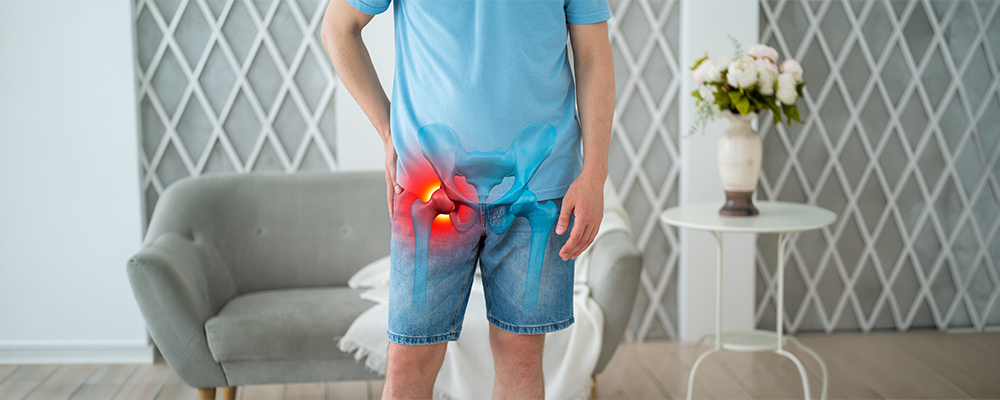
The hip joint is a ball-and-socket joint in which the rounded head of the femur fits into a cup-shaped socket in the pelvis called the acetabulum. Surrounding the socket is an elastic ring of cartilage, called the labrum. It deepens the socket and provides stability. Muscles, tendons, ligaments, and fluid-filled cushioning sacs called bursae ensure smooth and painless movement in virtually all directions.
Hip pain can originate from any of these structures. It can also be referred pain from the lower back or sciatic nerve. Once the source of the pain is identified, it can be effectively treated. Physical therapy is essential for relieving hip pain.
OA is the leading cause of hip pain in adults over 50. It develops when the protective cartilage lining the hip joint gradually wears away over time, eventually leading to painful bone-to-bone contact. Patients typically describe a deep, aching pain in the groin and inner thigh, which worsens after periods of inactivity and after prolonged activity.
Risk factors include age, genetic predisposition, previous hip injuries, obesity, and repetitive occupational stress. Physical therapy is the first-line treatment for hip osteoarthritis. Strengthening the muscles around the joint reduces stress on the cartilage and can significantly slow the progression of symptoms. Regular hip pain exercises significantly improve both pain and function in patients with hip osteoarthritis.
Bursitis occurs when the small fluid-filled sacs (bursae) that cushion the hip joint become irritated and inflamed. The most common type is trochanteric bursitis, which causes tenderness and aching in the outer thigh. The pain often worsens when lying on the affected side at night or after climbing stairs. Ileopectineal bursitis is less common and causes discomfort in the groin area.
Bursitis often affects runners, cyclists, and people who stand for long periods, as well as those with leg length discrepancies or weak hip muscles. Physical therapy focuses on strengthening the gluteus medius and improving IT band flexibility. It is very effective in treating bursitis without injections or surgery.
The labrum is a ring of elastic cartilage surrounding the hip joint. It can tear due to sports injuries, repetitive twisting movements, hip impingement syndrome, or structural abnormalities such as hip dysplasia. Labral tears are much more common than previously thought. Up to 22% of athletes complaining of groin pain have a labral tear. In patients with clicking or locking in the hip, 66% of labral tears were found.
Classic symptoms include sharp pain in the front of the thigh near the groin, a clicking or catching sensation with movement, and pain with hip rotation. Physical therapy is the recommended first-line treatment. It stabilizes the hip joint, retrains movement patterns, and strengthens the core muscles.
Hip strains are among the most common injuries among athletes and active people of all ages. Athletes very often complain of strains in the hip flexors and iliopsoas. They typically occur as a result of sudden explosive movements, inadequate warm-up, or gradual overuse. The hip flexors connect the lower spine to the femur. They become chronically tight in people who sit for hours every day. This contributes to pain in the anterior hip and lower back.
Treatment focuses on active rest, gradual reintroduction of weight-bearing, and targeted stretching and strengthening. This is precisely what the individualized physical therapy program at Mossy Creek Rehab provides.
FAI occurs when the ball or socket of the hip joint is abnormally shaped, causing bones to pinch together during movement. There are two types. Cam impingement is an abnormal femoral head shape. Pincer impingement is over-coverage of the socket. FAI is a leading structural cause of hip pain in young and middle-aged active adults. It frequently leads to labral tears if left untreated.
A telltale sign is a sharp “pinching” sensation deep in the groin when you bend your hip—for example, when getting into a car or sitting for extended periods. Physical therapy corrects movement patterns and strengthens stabilizing muscles to reduce the forces that occur during impingement.
Hip fractures are the most serious orthopedic injuries, especially in older adults with osteoporosis. They usually result from a fall, although fractures due to bone fragility can occur with surprisingly minor trauma. Symptoms include sudden, severe pain and an inability to bear weight on the affected leg. Hip fractures require immediate surgical intervention. Subsequent rehabilitation is equally important.
Physical therapy is a necessary part of recovery after a hip fracture. It helps patients gradually increase weight-bearing on the injured leg, train their balance, and implement fall prevention strategies to restore independence and reduce the risk of recurrence.
Not all hip pain originates in the hip. Sciatica, sacroiliac joint dysfunction, and lumbar disc herniations can cause pain radiating to the buttock, outer thigh, or back of the thigh. This so closely mimics a hip problem that many patients spend months being treated for the wrong condition. A thorough examination by a physical therapist is crucial to determine whether your hip pain is truly caused by hip problems or is coming from the spine.
Use this reference table to identify which condition may be contributing to your symptoms. Note that many hip pain conditions overlap. A professional evaluation is always recommended.
| Cause | Key Symptoms | Pain Location |
|---|---|---|
| Osteoarthritis | Deep aching, stiffness, worse after rest, reduced range of motion | Groin, inner hip, thigh |
| Hip Bursitis | Sharp outer-hip tenderness, worse lying on that side, aches at night | Outer hip, lateral thigh |
| Labral Tear | Clicking/locking, groin pain, pain with rotation, instability | Deep groin, occasionally buttock |
| Muscle Strain | Sudden or gradual aches, weakness, swelling, and bruising are possible | Front of hip, groin, lateral thigh |
| Hip Impingement (FAI) | Pinching sensation with flexion, groin pain after sitting | Groin, deep hip |
| Hip Fracture | Severe sudden pain, inability to bear weight, leg may appear rotated | Groin, upper thigh |
| Referred Back Pain | Diffuse ache, may radiate down leg, worsens with standing/walking | Buttock, outer hip, back of thigh |
Symptoms of hip pain vary greatly depending on the underlying cause, but there are several important patterns:
Red flag! If you suddenly experience severe hip pain after a fall, are unable to bear weight on your leg, or notice that your leg is turning outward abnormally, seek emergency medical attention immediately. This may indicate a hip fracture.
For mild, acute hip pain, the RICE method is a good starting point:
Over-the-counter NSAIDs can help manage pain and inflammation in the short term. If the pain persists for more than a few days or interferes with your daily life, it’s time to see a physical therapist.
This non-invasive approach treats the full spectrum of hip pain causes. Our therapist will conduct a comprehensive evaluation to identify the true source of your pain, assess movement patterns, and develop a personalized treatment plan tailored specifically to you.
Physical therapy for hip pain includes a combination of manual therapy, therapeutic exercises to restore strength and mobility, patient education on activity modification, and a progressive home program to maintain your gains between sessions.
The table below outlines the evidence-based PT strategies used for each of the most common hip pain conditions.
| Condition | PT Approach | Key Exercises |
|---|---|---|
| Osteoarthritis | Manual therapy, joint mobilization, pain education, activity modification | Clamshells, bridges, seated hip flexion, water aerobics |
| Bursitis | Soft-tissue mobilization, load management, gait retraining | IT band stretch, gluteus medius strengthening, side-lying abduction |
| Labral Tear | Movement retraining, hip stabilization, pre/post-surgical rehab | Clamshells, side-lying leg raises, core stability work |
| Muscle Strain / Overuse | RICE support, progressive loading, return-to-sport protocol | Hip flexor stretch, piriformis stretch, eccentric strengthening |
| FAI / Impingement | Movement pattern correction, hip strengthening, posture work | Glute bridges, hip external rotation, deep core activation |
| Post-Fracture Rehab | Weight-bearing progression, balance training, fall prevention | Seated leg raises, mini-squats, balance board work |
These exercises, recommended by physical therapists, are a safe starting point for most people with hip pain. Always consult your physical therapist before beginning. The right exercise for one condition may worsen another.
Lie on your back with one knee bent, foot flat on the floor. Cross the other ankle over that knee. Gently pull both legs toward your chest using your hands or a strap. Hold for 30 seconds, repeat 3 times per side. Excellent for outer hip tightness and bursitis.
Lie on your side with hips and knees bent at 45 degrees. Keeping your feet together, slowly raise your top knee like a clamshell opening—without letting your pelvis rotate. Lower slowly. 3 sets of 15 reps per side. Targets the gluteus medius, essential for hip stability.
Lie on your back, knees bent, feet flat. Press through your heels and lift your hips until your body forms a straight line from knees to shoulders. Hold for 2 seconds at the top. 3 sets of 15 reps. Builds posterior chain strength and reduces anterior hip impingement forces.
Kneel on one knee (the side being stretched), with the other foot forward. Gently shift your weight forward until you feel a stretch across the front of the kneeling hip. Hold for 30–45 seconds, repeat 3 times per side. Critical for desk workers and anyone with anterior hip tightness.
Lie on your side with legs straight. Slowly lift your top leg to about 30–45 degrees, keeping your toes pointed forward. Lower slowly. 3 sets of 15 reps per side. Strengthens the hip abductors, which support the pelvis during every step you take.
Not all hip pain is preventable, especially if it’s caused by structural factors or injuries. But several strategies can significantly reduce the risk:
You don’t need a physician’s referral to begin physical therapy in most states. Consider scheduling an evaluation at Mossy Creek Rehab if you experience:
Contact Mossy Creek Rehab today for your personalized physical therapy evaluation.
We are independent, family-owned, and proud to serve our local community.



 865-262-9044