Posted On: August 25, 2026 by Robert Matijevich
A woman can reach her forties or fifties, notice stiffer knees or hands that ache, and wonder whether menopause alone explains the change. Sometimes it does not.
Women face arthritis more often than men. The CDC reported diagnosed arthritis in 21.5% of adult women compared with 16.1% of adult men. The reason does not come down to one hormone or one body feature. Arthritis includes more than one disease, and the female disadvantage changes by arthritis type, age, immune biology, muscle strength, joint history, and menopause.
That distinction matters because women can act on some parts of risk. The right evaluation can also separate osteoarthritis, rheumatoid arthritis, and menopause-related joint pain before pain starts to control daily life.
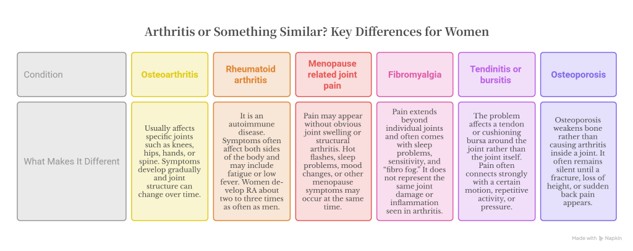
Osteoarthritis affects the whole joint, including cartilage, bone, and nearby tissues. Rates rise with age in everyone, but the female pattern changes sharply around midlife. Knee osteoarthritis becomes especially common in women after about age 50, which overlaps with the menopause transition.
Estrogen receptors exist in joints and other musculoskeletal tissues. Estrogen also affects immune activity, inflammation, and tissue repair. Yet hormones form only one part of a much larger picture. Immune function, genetics, joint mechanics, muscle strength, previous injuries, and age can all influence arthritis risk.
So estrogen matters, but evidence does not show that lower estrogen alone causes arthritis. A hormones-only explanation can also hide a previous joint injury, osteoarthritis, inflammatory disease, or another source of pain.
Middle age can bring several changes at once. Muscle strength can fall. Previous sports or work injuries can matter more. Body weight and activity can change. Menopause can add another biological pressure. Those factors may affect the same joint at the same time.
The 2026 Osteoarthritis Initiative study offers an important practical clue. Researchers followed knees without lateral knee osteoarthritis at the start and found that lower knee flexor and extensor strength explained roughly one third of the observed difference between women and men in lateral knee osteoarthritis risk.
That result does not mean muscle weakness causes every case of arthritis. It does suggest that strength represents one factor women may be able to improve through appropriate exercise and rehabilitation.
Anatomy adds another piece, but it does not tell the whole story. Women can have different knee alignment, joint geometry, and force patterns than men. Previous ligament injuries can also increase future joint stress. For many women, several pressures accumulate over time rather than one single cause.
Rheumatoid arthritis follows a different path. It is an autoimmune disease, which means the immune system attacks tissue around the joints. Women develop rheumatoid arthritis more often than men, but joint wear cannot explain that difference.
Researchers continue to examine hormone activity, X chromosome biology, immune responses, genetics, and environmental exposures. These factors may interact in ways that increase autoimmune risk in women.
Family history, tobacco use, age, and other exposures can also influence rheumatoid arthritis risk. Persistent joint puffiness, warmth, or prolonged stiffness after you wake deserves medical evaluation.
Common symptoms of arthritis include joint pain, stiffness, joint puffiness, reduced motion, and difficulty with ordinary tasks. Osteoarthritis often causes pain that relates to joint use and may affect the knees, hips, hands, or spine. Rheumatoid arthritis more often produces inflammatory symptoms such as joint puffiness, warmth, and prolonged stiffness.
Menopause-related musculoskeletal pain can complicate the picture. A 2026 BMC Medicine study followed women through the menopause transition and found links between pain across several joints and muscles, hormone changes, and common menopause symptoms.
That detail matters because menopause-related joint pain can feel very real without proving that arthritis exists. Osteoarthritis and menopause-related pain can also occur at the same time.
That overlap raises an important question: What if you dismiss arthritis as hormones and lose valuable time? You do not need to diagnose yourself. You do need to notice patterns.
Watch for signs of arthritis that persist or reduce function. Pain that repeatedly affects the same joint deserves attention. So do visible joint puffiness, warmth, prolonged stiffness after you wake, fatigue, or symptoms across several small joints.
A symptom diary can help. Note the joint, time of day, stiffness duration, visible changes, recent activity, and what improves or worsens the pain. That record gives a physician or physical therapist a clearer picture than a vague memory of a difficult week.
No woman can change age, genetics, or menopause. Other factors offer room for action.
Muscle strength stands out because muscles help control joints and absorb force. Regular movement can help preserve strength. A previous joint injury also deserves proper rehabilitation even after the first pain fades.
Excess body weight can increase mechanical stress on weight-bearing joints. Tobacco use can raise rheumatoid arthritis risk and affect health far beyond the joints.
The goal should never become self-blame. A risk factor of arthritis changes probability, not destiny. A better question asks which safe changes can help protect mobility now.
Arthritis treatment depends on the diagnosis. A physician may use medication, injections, or specialist care. Rheumatoid arthritis needs medical treatment that controls the underlying immune disease.
Osteoarthritis care often combines exercise, symptom management, education, weight management when appropriate, and physical therapy. Some people eventually need surgery.
Hormone therapy deserves a separate conversation with a qualified menopause clinician. Current evidence does not support hormone therapy as a standalone arthritis treatment. Joint pain still deserves its own assessment.
Physical therapy gives women a practical way to reduce arthritis pain and work on strength and balance at the same time. The Arthritis Foundation calls exercise one of the main non-drug treatments for osteoarthritis pain and function. A physical therapist can adjust exercise to the joint involved, current capacity, and personal goals.
At Mossy Creek Rehab, care may include an individualized exercise plan, mobility work, manual therapy, and education that helps patients pace activity without loss of what they value. The aim does not require a perfect joint. It asks the body to move with more support and less fear.
Mossy Creek Rehab has served Jefferson City and nearby communities since 2010. Its family-owned team emphasizes one-on-one care and customized treatment plans. Robert and Sherry Matijevich each offer more than 30 years of physical therapy experience, and Lindsay Matijevich adds another generation of local care.
At Mossy Creek Rehab, we believe arthritis care should protect what matters outside the clinic. Maybe that means a grocery store trip without planning every step, more time in the garden, more energy for grandchildren, or a return to exercise without fear of every ache.
We start with the person, not the diagnosis, and build a plan around real-life function.
Seek medical care when joint puffiness persists, a joint feels hot or red, stiffness after you wake lasts a long time, pain disrupts sleep, symptoms affect several joints, or function gets worse. A fever with a hot, swollen joint can require urgent medical attention.
If a physician has diagnosed osteoarthritis or joint pain has made movement harder, physical therapy can help you build a safer path forward. Contact Mossy Creek Rehab in Jefferson City at 865 262 9044 to ask whether physical therapy fits your needs.
Women face a higher arthritis burden, but higher risk does not equal helplessness. Better recognition, earlier evaluation, and stronger muscles can change the story from “I guess this is age” to “I know what I can do next.”



 865-262-9044